See it straight
Men and women are more similar than popular culture sells. Average differences exist but overlap is high. The few differences worth knowing are practical: women often read emotion and nonverbal cues a bit faster on average, lean slightly more affiliative in speech while men lean slightly more assertive, and respond best when support is matched to the actual need. These are tendencies, not rules about any individual woman.
Run the sequence
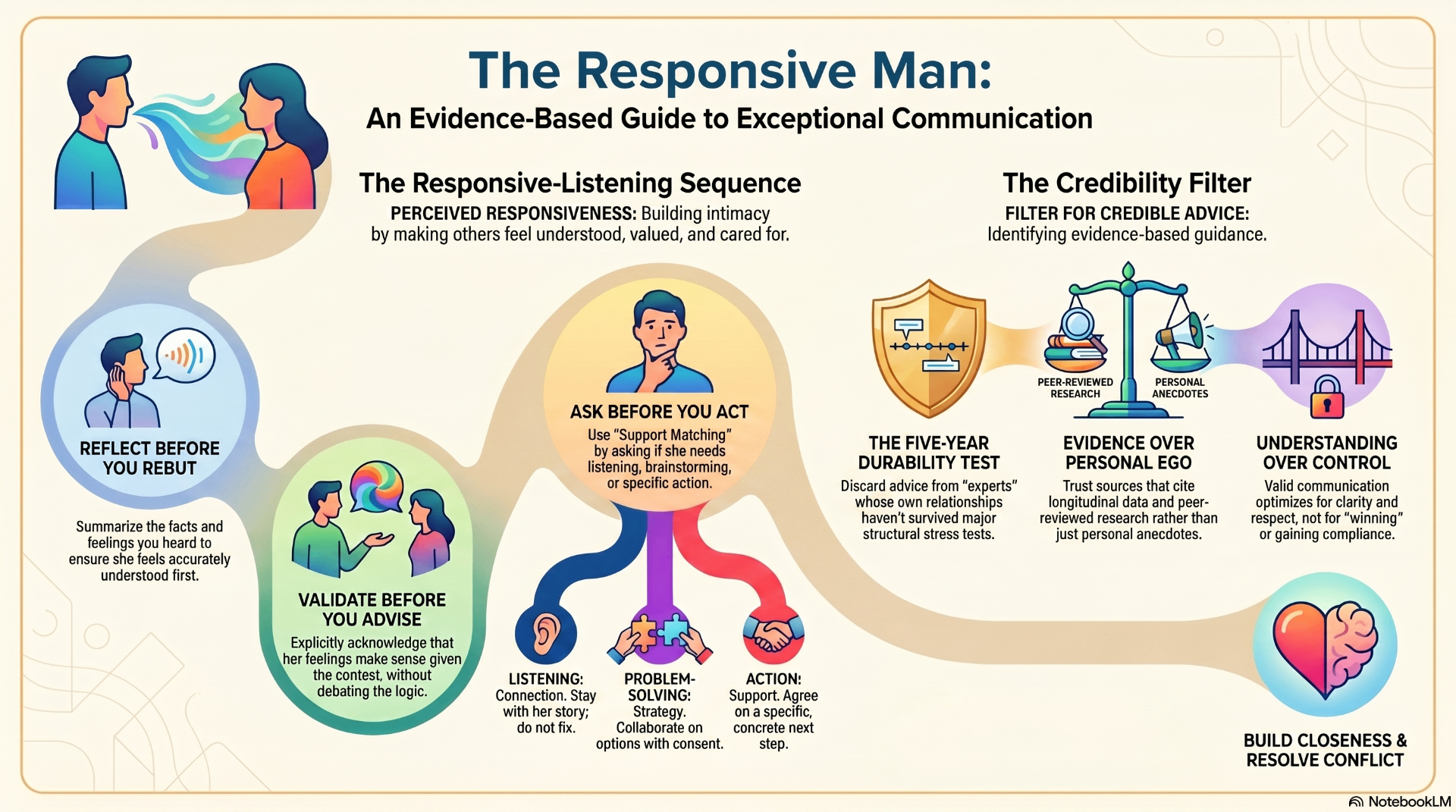
The core engine is responsive communication. Reflect before you rebut. Validate before you advise. Ask before you act. Then match the support.
What would be most useful from me right now?
Read the room
Same engine, different load. The move changes with the relationship.
Put in the reps
These are skills, not personality. You train them.
- 1Open without contempt
- 2Reflect
- 3Validate
- 4Own his part
- 5Ask what support is wanted
- 6Agree on a next step
- 7Follow up
- →Brings the content
- →Names the kind of support she wants
- The ninety-second no-fix rule
- The support menu (ask: listening, brainstorming, action, or space?)
- The soft-start rewrite (turn "you never" into "can we talk about")
- The 24-hour follow-up
Vet who you learn from
Before you adopt anyone's framework for talking to women, screen the source as hard as you screen the advice. Most bad outcomes come from confident instruction by people who have never been tested.
Six months in and sure he understands women. He understands one woman, in the one phase where almost anything is forgiven. Early love is reward chemistry, and it is temporary.
A coach whose own track record is shorter than five years has not seen a real structural stress test. He cannot teach repair, because nothing of his has needed repairing.
The least calibrated voices are often the loudest. Confidence is not evidence.
A wall of wins is a sample with the failures removed. It hides the denominator.
The moment the goal is getting her to do something rather than understanding her, you have left communication for persuasion.
Track record longer than five years?
The filter has to be you.
Use AI as a guide, not a guru
This pays off Step 5. The filter has to be you, so the AI is a sparring partner, not an oracle. Use it to rehearse a hard conversation, pressure-test a message before you send it, or walk a specific relationship through the sequence. The judgment stays yours.
Live the seven
Everything above is the evidence. This is the practice. Seven principles, run across every relationship that matters.
- 01
She is a person first. The state is unconditional love, the 1 Corinthians 13 definition: patient, kind, keeps no record of wrongs.
- 02
Be present. With everyone. Not half there with one eye on the phone.
- 03
Quick to listen, slow to speak, slow to anger. The order is the whole point.
- 04
Know what is most important to them, and how they know when they have it.
- 05
Plan your responses ahead. There is nothing new under the sun.
- 06
Be relentlessly truthful in love, and plant the truth in fertile ground.
- 07
Be the best man I can be for them.
Be the best man you can be. Slow to speak, quick to listen, and slow to anger.
Take it further
Tony Robbins, Ultimate Relationship Program.
Robbins has worked in this field for more than four decades, which puts him well past the five-year durability test from Step 5.
The research behind this
This guide is fully cited. The complete bibliography lives in the downloadable PDF. It rests on work such as Hyde's gender similarities hypothesis, Gottman on conflict, Reis on perceived partner responsiveness, Cutrona on support-matching, and Kruger and Dunning on overconfidence.